The building
Bentley's Byzantine design
Why Westminster Cathedral looks Byzantine, not Gothic: Cardinal Vaughan's brief, Bentley's tour of Italy, the brick, the concrete domes and the one tower.
Book a seat under the domes ↗Quick answer
Westminster Cathedral is Byzantine because Cardinal Vaughan wanted a broad nave, a structure that could be built first and decorated later, and no rivalry with the Gothic Abbey. John Francis Bentley toured Italy in 1894 and 1895, then built in red brick and stone bands with concrete domes and no iron. It was finished in 1903.
The brief
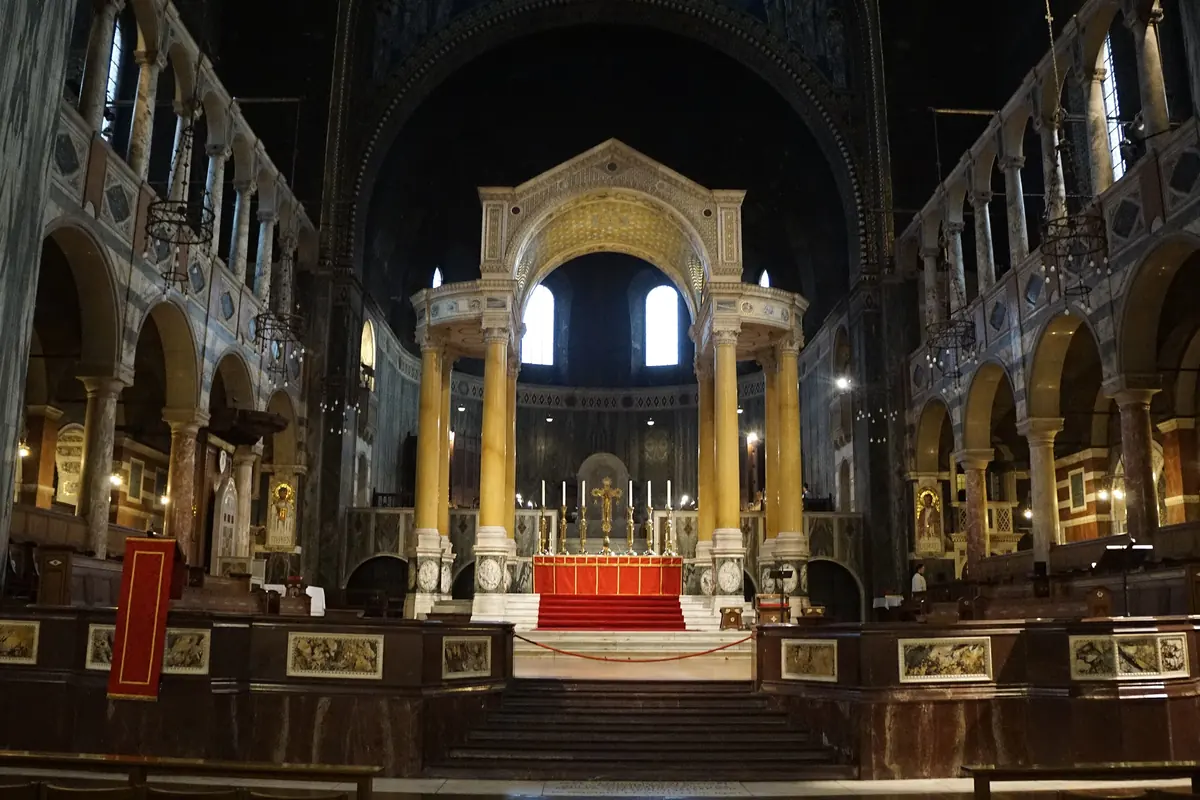
Cardinal Vaughan promised a cathedral within ten years but had limited money. His own pages record three requirements: a broad uninterrupted nave with the high altar as the focus, a structure that could be completed first with decoration to follow, and a building that would not compete with the Gothic grandeur of the Abbey. Brick was far cheaper than stone, and the Cardinal wanted a living example of daily choral worship at the centre of the Empire. The result was a church that looks to early Christian Rome and Byzantium instead of medieval England.
The architect
John Francis Bentley was born in Doncaster on 30 January 1839 and trained in London building and architectural firms. He became a Catholic in 1862, taking the baptismal name Francis. Vaughan declined a competition and appointed him in July 1894, though his earlier work was neo-Gothic and nothing in it hinted at Byzantium. Bentley had lost a competition early in his career and never entered another. The cathedral's pages describe him as a craftsman who loved colour and fine materials, which suits a building meant to be clothed in marble and mosaic.
The tour of Italy
In November 1894 Bentley set off for Italy with Vaughan's brief. He visited Milan, Pavia, Pisa, Naples and Rome, where he disliked the baroque scale of St Peter's, and then Ravenna and Venice. An outbreak of cholera kept him from Hagia Sophia in Constantinople, so he relied on a study of the building published in 1894. He was home in March 1895. By then he had decided that the early Christian style Vaughan preferred would not serve, and he moved towards his own version of Byzantine design.
Brick, stone and concrete
A formal design was approved in 1896, a year after the foundation stone was laid. The red-brick and Portland stone stripes borrowed their pattern from mansion flats on nearby Ambrosden Avenue, and the choice of brick let the church rise quickly. Bentley resisted iron, so the domes and vaults are concrete. He planned for the lower walls to be clad in marble and the upper reaches in mosaic, a scheme that explains the bare brick high up today.
Read next: The unfinished domes
One tower, not two
Bentley's original plan had two campaniles, and Vaughan refused. The single bell tower stands at 284 feet according to the cathedral, can be seen across the city, and has a lift to a viewing gallery. Carved stone eagles encircle its apex. Alfred Hitchcock's Foreign Correspondent from 1940 builds its finale on the tower, and the cathedral notes that Hitchcock's wife was baptised and confirmed there in 1927. The tower is the landmark that tells you the cathedral from the Abbey, even from far away.
A cathedral on a prison
The site was the former Tothill Fields prison, bought in 1884 by Cardinal Manning, Vaughan's predecessor, as eight acres of land already part-built on a solid concrete foundation. Bentley kept the old prison's foundation, which is why a building of this size has a relatively small crypt. Vaughan died in 1903, and the work of clearing the debt passed to his successor, Cardinal Bourne. The debt was cleared in April 1910, and the cathedral was consecrated in the last days of June that year.
Who this isn't for
A full architectural survey lies beyond this guide. It covers the origins of the design, not every chapel or mosaic, and the cathedral's own pages go much further. It is also not about the show itself. The tickets guide covers booking, and the guide to the unfinished interior explains what the projection plays across.
Frequently asked questions
Why is Westminster Cathedral Byzantine?
Vaughan wanted a broad nave and a design that did not compete with the Gothic Abbey. Bentley chose a Byzantine style after a tour of Italy.
Who built it?
John Francis Bentley designed it for Cardinal Herbert Vaughan, and the firm Shillitoe and Sons of Bury St Edmunds won the building contract.
Is the cathedral made of stone?
Mostly brick, banded with Portland stone. The domes and vaults are concrete, because Bentley resisted iron.
Sources